|
|
|
National Observer No. 69 -Winter 2006
Exposing Environmental Myths about the Great Barrier Reefby Walter Starck National Observer
Over the past four decades, hardly a year has passed without some dire threat to the Great Barrier Reef being proclaimed. Crown-of-thorns starfish, over-fishing, tourism, anchor damage, pesticides, fertilizer, cattle, cane, oil shale, coastal development, roads, marinas, shipping, global warming and sundry other menaces have repeatedly been declared to threaten the reef, and “experts” cited in support. None of these things has ever been dealt with in any effective manner, yet the reef remains much as it has always been. Credibility, however, never seems lacking for another threat nor for more expert opinions. Although reefs in many other parts of the world have indeed been damaged by human activities, the Great Barrier Reef is among the most pristine of reef areas. Distance, weather and a relatively small population mean most of the reef is rarely ever visited. Of the 2,900 reefs in the complex, only a few dozen are regularly used for tourism and the total annual fish harvest per km 2 is less than one per cent of what reefs elsewhere commonly sustain. Solutions appropriate to the problems of heavily-impacted reefs are uncalled for and may even have undesirable consequences here. No-take areas, limited licences, quotas, closed seasons, size limits, gear restrictions and other such limitations have proven effective where fishing pressure is high and stocks over-fished. However, they are of no utility where fishing pressure is well below sustainable limits and substantial breeding stock is widespread as on the Great Barrier Reef. The benefit from such measures here is un-needed, undemonstrated and unlikely, yet all these and more are being imposed without even any plan to monitor and evaluate their effect. In other words, we will be stuck forever with a multitude of restrictions which we don’t know are either needed or effective, and have made no effort to find out. Calling this “precaution” defies common sense. It is indeed just the opposite. It amounts to wholesale environmental meddling for no good reason, with no idea of the consequences, and no intention of ever determining them. The Great Barrier Reef commercial fishing harvest is now limited to an annual quota of 3,061 tonnes. Averaged over the 347,000 km 2 of reef and lagoon area in the Great Barrier Reef, this comes to just under 9 kg/km 2/year. The average harvest over a broad range of reef areas elsewhere in the Pacific is 7,700 kg/km 2/year, and even the conservation NGO World Resource Institute cites 4,000 kg/km 2/year as being a sustainable level for coral reef fisheries. Coral trout are the most heavily fished species on the Great Barrier Reef. For over two decades, the Great Barrier Reef Marine Park Authority has funded extensive underwater surveys of coral trout populations, but has never published the results. As to what the surveys actually show, you don’t have to take my word for it. Dr Tony Ayling has conducted most of the trout surveys and, about two years ago, there was a most interesting summary by him on the Internet. It was removed shortly after I had called attention to it in public debate regarding the expanded green zones. It was entitled: “Where are all the coral trout? Or are coral trout numbers on the Great Barrier Reef being reduced by current levels of fishing?” Here are a few salient quotes from this document: • “… it is obvious that coral trout numbers have not increased on reefs that have been closed to fishing.” • “All these figures suggest that far from decreasing in numbers there has been a marked increase in the numbers of coral trout on the GBR [Great Barrier Reef] over the past 10 years.” • “The Marine Park Authority and DPI [Department of Primary Industries] have made recent estimates of the total annual catch of coral trout from the GBR of about 2 million kilograms, including both the recreational and commercial catch. Given the average size of coral trout, this equates to about 3 million fish or only about 10 per cent of the available stock.” • “… the annual input of young coral trout is equivalent to about 40 per cent of the available stock, far higher than the annual catch of 10 per cent of available stock.” • “… it seems unlikely that the present exploitation levels of coral trout on the GBR are any threat to coral trout numbers.” After discussing the popular perception of declining trout numbers and the effect of frequent fishing on catchability, as opposed to the actual numbers of fish present on a reef, he concluded with the statement: “Just remember: the number of fish that are caught does not relate to the number of fish that are there, but to how easy they are to catch.” In addition to the trout surveys, the Great Barrier Reed Marine Park Authority (GBRMPA) has funded a large-scale, long-term study of the effects of line-fishing on the Great Barrier Reef. During the Green Zones debate, the authority repeatedly claimed that this study provided proof of the need to further restrict fishing. Unfortunately, the formal report of this decade-long study was not published until just after the expanded zones were finally decided. The actual conclusions of the study present a quite different picture than GBRMPA had claimed. Here are four key points from the final conclusions of this report that I have translated from techno-speak into English: • Coral trout populations were predicted to remain “robust” under all the future projections that were considered. • The likely effect of additional area closures would be poorer fishing. • No evidence was found that fishing had any detrimental effect on the reef community. • Closing more areas to fishing could be expected to increase the impact of fishing in areas left open. Although the GBRMPA has claimed there has been a decline in trout, there is simply no evidence for this. DPI catch statistics show that both the total harvest and “catch per unit of effort” for recent years are near an all-time high. There is no evidence of decline. In a current GBRMPA-sponsored public opinion survey on “Threats to the condition of the GBR”, it is stated that commercial fishing has doubled since 1995. This is also untrue. On the contrary, it has actually decreased. The commercial harvest in 1995 was 3,183 tonnes. It is now limited by quota to 3,061 tonnes. Figured over the entire reef and lagoon area, the boats participating in the Great Barrier Reef commercial line fishery enjoy an average density of over 500 km 2 per boat. The average number of days fished per boat however is only about 50 per year, thus the mean fishing-boat density comes to over 4,000 km 2 per boat on any particular day. For all practical purposes, commercial fishing pressure on the Great Barrier Reef as a whole is virtually non-existent. If one were arguing over whether the Great Barrier Reef harvest rate should be 4,000 kg/km 2/year or 5,000 or only 3,000 or even 1,000, there might be a genuine debate; but to argue that it should only be 9 kg or less than 1/10 of a kilogram/ha per year is simply absurd. To do so with no supporting evidence, while ignoring all of the standard measures of fishery science, has to be either dishonesty, incompetence or both.
Economic Value In addition to the ongoing misinformation that has been promoted with regard to over-fishing, the economic value of the industry has also been grossly misrepresented. GBRMPA has widely claimed the value of Great Barrier Reef-based tourism to be worth $3.5 billion and the reef component alone as being $1.4 billion. They also have often cited the value of commercial fishing as being only about $119 million. The actual reef component of most visitors’ stay is a single day-trip during which they spend a few hours on the reef and only about half of all visitors to the region even visit the reef at all. The value of reef tours at about $150 million is in fact very close to the value of reef-based commercial fishing at about $130 million. Attributing the total value of all regional tourism to a one-day visit to the reef by about half of all visitors is no more justifiable than would be attributing it all to commercial fishing, based on the fact that most visitors eat local seafood during their stay. When the value of recreational fishing at about $240 million is added, the value of fishing activity can be seen to be over twice that of reef tourism. In the lead-up to the recent large expansion of green zones, GBRMPA also estimated the impact on commercial fishing to be between $0.5 million and $2.5 million. The Great Barrier Reef fishing industry compensation cost estimate has now blown out to $150 million, and some think it may come to $200 million before completion. On top of this is the ongoing economic loss which a University of Queensland study has estimated to be $23 million annually in foregone production.
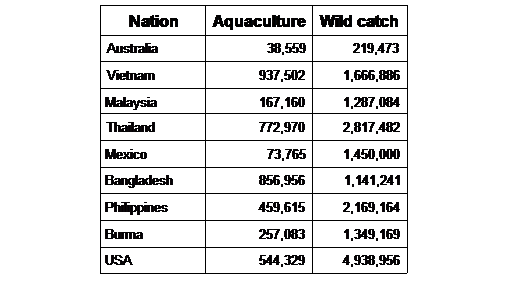
Collapsing Fisheries On a national scale, the situation of our fisheries is not much better. Australian landings have averaged about 220,000 metric tonnes over the past decade. In comparison, the U.S. harvest is currently over 20 times greater. Below are some fishery production figures (in metric tonnes) for 2003. The first is aquaculture, the second for wild caught (see table below).
TABLE: Fishery production in metric tones for 2003
A comparison with the fishery production figures of some of our neighbors to the north is instructive. Vietnam, Malaysia, Thailand, Bangladesh, the Philippines and Burma each have only a fraction of the Exclusive Economic Zone (EEZ) area of Australia, and each is producing from five times to over 25 times more wild-caught harvest than Australia in addition to from four times to over 20 times greater aquaculture production. In the U.S., the relatively small sub-tropical Gulf coast region alone produces over three times the total commercial catch of all of Australia, while the Florida Keys, with less than one per cent the reef area of the Great Barrier Reef, sustainably supports a larger catch than the entire GBR. The figures speak for themselves, especially in view of our much larger and less impacted coastline and marine environment. Australia has the world’s third largest EEZ, behind the United States and France, but ahead of Russia. The total EEZ area actually exceeds that of our land territory. In terms of EEZ area, the Australian fisheries harvest rate is about 1/20 that of the U.S. Australia’s continental EEZ area comes to 6,048,681 km 2, and the island territories bring the total to 8,148,250 km 2. Disregarding the latter, the wild-caught harvest comes to just under 40 kg/km 2 per year or 0.4 kg/ha. Over-fishing is simply not a widespread problem with Australian fisheries. The real problem causing the malaise in fisheries is ill-conceived government-imposed restrictions, demands and charges. There is also far too much armchair management based on theories and computer models, too little direct empirical assessment of the resource and too little management input from the industry itself. The result is an imposition of hypothetical solutions to imaginary problems with increasing demands on fishermen that have become impossible for increasing numbers of them to meet. With our small population and vast EEZ, we still do not even produce enough seafood to meet domestic demand. Imports now amount to 70 per cent of consumption by edible weight and cost $1.8 billion. All we are doing is adding our demand to more heavily impacted fisheries elsewhere and shifting the impact here onto other resources to pay for it. Unable to comply with government demands and remain profitable, growing numbers of fishermen are giving up and selling out. In the more valuable fisheries, their licences and quotas are being bought up by corporations with the resources and clout to deal with the bureaucracy. The companies then enjoy a profitable government-provided monopoly, and government finds management easier. Divvying up valuable natural resources can be quite lucrative to the favoured few. Whether this outcome is the deliberate aim, or simply an inadvertent consequence of incompetent management, could be debated. I tend to favour incompetence, but such assessment may well be too kind. The following quote from a speech in March 2003, by the then Commonwealth Minister for Fisheries, Forestry and Conservation, Senator the Hon. Ian Macdonald, is revealing. He stated: “Despite having the third largest EEZ on the planet, the Australian seafood harvest can’t meet the demand for the Australian seafood consumer. And the underlying reason for this, I’m told, is that Australia is in the middle of, you might say, a fish desert. Unlike South Africa and South America, we don’t have any major sub-Antarctic currents carrying the very nutrient-rich cold water towards the equator where it mixes with the warm tropical waters and creates a perfect environment for what we might consider ‘super’ fish production.” This statement makes clear that the minister had been badly misinformed. While it is true that Australian waters do not have the “super” productivity of those of South Africa or Peru, productivity here is far from being a “a fish desert” and is similar to that of most tropical and warm-temperate regions around the world. This is readily apparent in satellite measurements of chlorophyll content, a basic indicator of marine productivity. The new $220 million structural adjustment package for Commonwealth fisheries is intended as compensation payments in a plan to reduce the Commonwealth-licensed fishing fleet by half (from 1,200 to 600 vessels). This would be hard to believe if it were not true. After loading the industry with increasing demands and restrictions — which make it impossible for growing numbers of fishermen to operate profitably — the resulting difficulties and reduced catches are then used to justify further cutbacks. The minister might well find that a fact-finding visit to Vietnam or Bangladesh would be more genuinely informative for him than the advice coming from his own experts. In fact, he wouldn’t even need to go overseas. He could just interview some of the 13,000 illegal foreign fishing vessels reported in our northern waters last year. If we are in the midst of a “fish desert”, why are so many coming so far and risking so much? Sunbathing, perhaps?
Australian Fisheries Management In the past, fishing was regulated chiefly by fishery departments whose budgets and importance were directly related to the condition of the industry. In recent years, however, sundry other regulatory agencies involved with various aspects of health and safety, the environment and parks have begun to impose demands, while both Commonwealth and state fishery departments have increasingly expanded and overlapped. Many of these new regulators have little understanding of the realities of the industry or concern for the impact of their demands. The whole approach to fishery management has also undergone a sea change. In the past, maximum sustained yield was the ideal and monitoring of the fishery itself was the primary methodology. Now we have a new generation of fisheries biologists schooled in theories and enthralled by sophisticated computer models based on simplistic assumptions about complex and highly variable phenomena of which we genuinely know very little. Although such models can be of value in gaining insights about the possible dynamics of a resource, their output is fraught with many uncertainties. Typically, they require generous tweaking to yield results that are within the bounds of credibility and they thus tend to reflect more the assumptions, aims and adjustments of the modeller than anything in reality. On top of all this has come the rise of environmentalism and a growing attitude across an increasing urban majority that primary producers are exploiters who need to be severely curtailed if not stopped altogether. To many, the environment has acquired a near sacred status. Though themselves voracious consumers of natural resources, these urban dwellers are divorced from the production that supports their demands and tend to see the producers who supply them as greedy exploiters and even as defilers of the sacred. Ironically, their own chosen lifestyle has virtually annihilated the natural world in the environment in which they themselves choose to live. The sacred nature of the environment manifests itself in language where “fragile” and “delicate” have become almost mandatory adjectives in describing the natural world. A peculiar corollary of all this has been the precautionary principle which mandates that any imagined possibility of an environmental problem must be addressed with full measures to prevent it. One can’t be too careful when dealing with anything so precious as the environment. Unfortunately, this principle makes no reference to probability, cost or consequences of risks, and it offers a ready cloak for other agendas. Followed to its logical conclusion, it would have us all wearing crash helmets and condoms 24 hours a day as well as taking chemotherapy, just in case. In fact, it even precludes itself. Everything we do — and indeed even what we don’t do— entails risk. This includes precautionary measures themselves. Amazingly, this vacuous and pernicious piece of nonsense has actually been written into the enabling legislation for the Australian Fisheries Management Authority 4. Management of our fisheries has become divorced from the realities of the industry, the nature of the resource itself and our best understanding of its condition and dynamics. Fishing is a demanding, uncertain, often even dangerous, business. The ability to bear added costs and restrictions is not unlimited and their imposition should only be considered with due care. The natural communities upon which our fisheries are based are not fragile and delicate but rather robust and flexible ones that readily recover from relatively frequent natural perturbations. There is little risk in monitoring fisheries and addressing problems if and when they become apparent, rather than trying to take elaborate pre-emptive action to avoid an endless array of imaginary possibilities. In view of our ignorance and the complexity of the matters involved, it would also be prudent to test measures before applying them on a broad scale and to assess carefully their results when implemented. In general, a much more empirically-based approach is needed. Management decisions should be based on what is actually happening in a fishery, not theories and models. Regulation should be imposed only where a demonstrated need exists and results should be monitored and evaluated. Much stronger involvement of the industry in formulating management measures is essential to insure that the form of demands is appropriate to the needs and realities of the fishery. Management by theory without broad and ongoing assessment of actual conditions and results is a recipe for ongoing decline.
Aquaculture Over the past two decades, there has been an explosive growth in aquacul-ture. In 2004, global aquaculture production had grown to some 55 million MT. This equals about 60 per cent of total wild-caught production, or all of wild-caught production in 1970. Aquaculture is in fact the fastest-growing food production sector in the world. Since 1970, it has averaged a compounded growth of 9.2 per cent per annum. Australian aquaculture production currently produces about 40,000 MT annually, or a bit under 1/10 of 1 per cent of world production. In comparison, Canada produces about four times this amount despite its limiting climatic conditions. The U.S. (Fig. 13) produces nearly 14 times this amount, and Japan some 32 times as much. Australia, with 66,530 km of mostly uninhabited coastline well suited for aquaculture, a benign climate and unpolluted waters, clearly has vast undeveloped potential for the expansion of aquaculture.
Aquaculture Regulation Despite ideal natural circumstances, development of aquaculture in Australia is stagnating. The only real obstacle to a hugely increased development of the industry here is a morass of environmental regulations. The uncertainties, costs and restrictions imposed by these are prohibitive. Ask anyone who has attempted it. The result is that, despite our natural advantages, we have little large-scale aquaculture while the industry is booming throughout the rest of the world. For example, here in Queensland the legal determination of protected coastal wetlands encompasses all areas subject to tidal inundation by the highest astronomical tides. This includes large regions that are “wetlands” only by this definition. Ecologically, they would be better described as coastal salt plains. They are characterised by low biodiversity, low productivity communities of a few salt-resistant plants struggling to survive on what is normally dry land but is occasionally inundated by salt water. These areas bear no real relationship to the rich highly productive natural communities of genuine wetlands. Even more insane is the classification of all plants growing in such areas as protected marine plants that cannot be disturbed in any way. This even goes so far as to forbid removal of dead seaweed washed up on beaches. And this is only for starters. There are a host of additional regulations administered by a variety of different authorities with broad discretionary powers to impose demands and conditions to address problems that do not have to exist or even be likely but simply imagined as possible by the administering authority. Along thousands of kilometers of coastline there are extensive areas of such low-lying salt-affected areas. Both ecologically and economically they are virtual wastelands as they exist naturally. They are, however, ideal for aquaculture development and could be the basis for a multibillion dollar industry with minimal detrimental impact. The only thing preventing this is the regulatory morass. A 50-hectare barramundi farm can produce about 600 MT of product annually. Moreover, such an operation would also, in fact, create a significant area of biologically-rich perennial wetland in the form of settlement ponds. The farm-gate value of 600 MT of barra is about $6 million. To produce $6 million in sugar requires about 2000 ha. of good agricultural land. For cattle, it takes about 100,000 ha. of grazing land. From the standpoint of maximal return for minimal environmental impact it is hard to imagine anything more valuable and ecologically beneficial than aquaculture. The only reason it is not a booming industry here is bureaucracy and eco-nonsense. As with fisheries, much of the problem of the industry stems from the pursuit of an imaginary eco-correctness and management by theory and precaution. Again, a much more empirically-based approach is sorely needed.
Economic Value A CSIRO study estimates that, by the year 2020, an additional 610,000 MT of seafood will be needed to meet growing demand. This amount represents an almost 400 per cent increase in imports over the next one-and-a-half decades. Harry Peters, president of the Australian Seafood Importers Association has stated: “This must be imported, as wild catch resources are at capacity and Australian aquaculture cost of production is much higher than world average.” 5 Although this statement does seem to reflect current belief, it raises two very important questions. Is the relatively low level of the Australian wild-catch fishery really at the limit of capacity for the resource? Is an annual harvest of only 0.4 kg/ha. actually the maximum that our waters can sustain? Another important question posed is why should Australian aquaculture be at a cost disadvantage to Europe, North America or Japan, all of which have booming aquaculture industries much larger than Australia’s, despite more difficult natural conditions plus equal or greater cost for land, labour and equipment? The overwhelming disadvantage of Australian aquaculture is clearly neither natural nor economic but government-imposed restrictions, demands, charges and uncertainties.
Seafood in Diet and Nutrition In recent decades, seafood consumption has increased substantially in most developed countries. Growing affluence and a greater range of food choice, combined with changing culinary tastes plus an increased awareness of health benefits from seafood, have all contributed to its increased popularity. In the past, seafood tended to be a cheaper, less desirable alternative to traditional meats from domestic animals. Now, it has the status and price of gourmet cuisine. In the late 1930s, Australian seafood consumption was only 4.9 kg per capita per year. Annual per capita consumption is now 20 kg. Increasing appreciation of the nutritional and health benefits of seafood make further growth in consumption seem probable. Seafood is an excellent source of proteins and is low in fats, cholesterol and sodium. It is also a good source of minerals and some vitamins. It is easier to digest than red meats and poultry, and is among the most nutritionally balanced of foods. It aids weight control and is highly beneficial in preventing heart disease. In particular, seafood is high in essential omega-3 fatty acids which are deficient in most terrestrial foods. Their consumption has been found to be beneficial in preventing or alleviating asthma, arthritis, diabetes, multiple sclerosis, hypertension, migraine headaches, cancer and some kidney diseases. They also play a vital role in neurological development and functioning. 6 A diet rich in seafood facilitates brain development in growing children and has been found to be beneficial in the treatment of depression and schizophrenia in adults. Fish really is a brain food and it would quite literally be stupid to continue to mismanage our fisheries. As a Queenslander, I find it particularly ironic that we call ourselves “The Smart State” while closing down our fisheries and preventing aquaculture from even getting started.
Sociological Considerations Fishermen today face an array of opposing interests and widespread misinformation. Environmentalists, researchers and the bureaucracy all have a vested interest in environmental problems and, with the precautionary principle in place, these don’t even have to be real but simply possible. Then there are the media, always looking for dramatic news and happy to provide coverage for every claimed threat; an increasingly urbanised population who know only what the media report; and politicians responding to, and themselves believing, the popular misperceptions. A further major difficulty with respect to fisheries issues it that the reality is offshore and underwater. Real knowledge is sparse, and the little we do know is usually inferred and uncertain. Almost anything can be claimed with little danger of being found untrue. The only people with any direct experience are fishermen and a few researchers. Fishermen have little public voice and, when heard, are believed only if they agree with the popular view. The few researchers with direct experience and information are either receiving funding to study the “problem” or are employed by institutions to which such funding is important. Questioning the existence of a problem or threat will at the very least ensure personal criticism and ostracism. Most likely, it will also have an adverse effect on obtaining one’s own research support and could even be career-threatening. In the end, speaking out is unlikely to have any positive effect. Not surprisingly, public dissent from researchers on claims of marine environmental problems is rare. The absence of real understanding and a proliferation of office-based management coming straight from the degree mills with no experience of fisheries have resulted in a management approach based largely on theories and models with little reference to any empirical assessment of the actual resource and scant regard for the practical realities of the industry. The precautionary principle disposes of any uncertainties, while the righteousness of saving the environment justifies any hardships imposed. How far current trends will proceed is impossible to predict. Economics plays a key role. Bureaucratic nonsense is costly. It is only affordable in a healthy economy. In a recession, decisions of affordability must be made. The number of new laws and regulations being introduced is unprecedented in human history and their mass tends to be cumulative as few are rescinded. The effort and expense of compliance and their repressive effect on productive activity are not without limits. When and how this limitation may be dealt with are not apparent, but the eventual necessity seems inevitable. Increasing longevity and a below-replacement level birth-rate is now characteristic of developed countries. The coming demographic crunch is going to require more food from fewer producers, and artificial impediments to their capacity to produce will have to be removed. Looming over all is the increasing cost of energy, uncertainties regarding its supply and the global politico-economic consequences of its availability and cost. Ideally, we need to utilise all our resources and spread our impact across our entire resource base. Every resource we lock up puts more pressure on others and creates increasing imbalance.
A Better Way Forward Another, better way forward is possible. Despite large differences of opinion, there is a common ground from which to start. No one wants to see our resources and the world we live in degraded. Differences over conditions, values, trade-offs and management cannot be resolved by opinions, no matter how “expert”, or beliefs, no matter how devout. Real world evidence must be gathered and assessed in an open and transparent manner. All relevant evidence and interpretation must be considered. Balance of evidence, risks, benefits and costs all require consideration. All conclusions should be treated as tentative and subject to change on the basis of additional evidence and assessment. In many of these matters, we truly know very little. We need to know that we don’t know and be open to new evidence and interpretation. Forget “fragile” and “delicate” — these are robust, renewable resources. If mistakes are made, we can pull back or change direction, and conditions will recover. The precautionary principle is mainly an emotive expression of political correctness. Precaution with no evaluation of risk or cost is vapid nonsense and has no place in competent, rational environmental management. In short, a much more empirical, rational, evidence-based and experimental approach to management is sorely needed. The problems of our fisheries, in most instances, are not with over-fishing, but rather with our current approach to management. Lobbying for more enlightened management is likely to achieve little. Three things that would make a huge difference are: • Strong industry representation in management decisions. • Budgets for management should be indexed to performance, including the production and profitability of the industry. • Management must become open and transparent. This is the Internet Age. Data, models, rationale and other information relevant to management decisions should be made open to public access via the net. The current process of issuing dictates based on unverifiable claims, undisclosed models, unknown methods and inaccessible data amounts to faith-based management. These changes are eminently practical, in accord with fundamental democratic rights and good management practices. The only real requirement for their implementation is the will to do so.
ABOUT THE AUTHOR: Walter Starck is one of the pioneers in the scientific investigation of coral reefs. He grew up in the Florida Keys and received a Ph.D in marine science from the University of Miami in 1964. His half-century’s work has encompassed the discovery of much of the basic nature of reef biology.
National Observer No. 69 - Winter 2006
|


.jpg)